Description
All 82 tools across every source toolkit and every bundle above — course design, materials creation, assessment, attention, culture, motivation, classroom practice, and marketing — in a single purchase. Built for anyone who’d otherwise buy three or more of the smaller bundles separately; at £49.99 it’s priced below buying the CCM, Course Architect, and Educator’s Mind toolkits individually.
What’s inside 82 tools
Design core 9
The Course Treatment Generator
Before you build a single lesson, write the treatment — the pre-production document that captures what your course is really about.
The Director's Treatment Template
A director's treatment captures the feel of a course before a frame is shot — tone, look, voice, and the promise to the learner.
The Five-Part Sequence Builder
Every cinematic lesson has the shape of a scene.
The Logline Builder
Distil your whole course into one sentence — the transformation at its heart.
The Save the Cat Beat Sheet
Snyder's fifteen beats, adapted for a course.
The Story Circle Mapper
Dan Harmon's eight-step circle, applied to learning.
The Story Structure Mapper
Map your course onto the beats of a story — the structure that's held human attention for millennia.
The Theme & Motif Designer
Your course has a surface topic and a deeper argument.
The Three-Act Weighting Calculator
Most courses front-load setup and rush the payoff.
Learner and character 3
The Identity Transformation Arc
Change the identity and behaviour follows.
The Learner's Arc Designer
Seven psychological mechanisms drive real transformation.
The Lie & Possible Selves Worksheet
Every transformation starts by naming the lie the learner believes — and making the possible self vivid enough to pull them forward.
Assessment and transformation 4
The Ordeal Designer
Plot your course's challenges on the two axes that decide whether difficulty transforms or just threatens: how hard it is, and how safe it…
The Resolution Planner
How a course ends decides what learners keep.
The Rubric & Evidence-Portfolio Builder
Assessment should prove who the learner has become.
The Transfer Framework Planner
Learning that stays in the classroom isn't learning.
Culture and engagement 2
The Community Architecture Designer
Community doesn't happen by adding a forum.
The Rituals of Becoming Designer
Rituals are the heartbeat of culture and the markers of identity change.
Production and editing 2
The Braintrust Session Planner
Pixar's Braintrust gives honest critique in service of the work, never the person.
The Director's Notebook
After every cohort, the director reflects before the next cut.
Marketing and launch 2
The Audience & Avatar Profiler
You can't market to a blur.
The Trailer Script Structurer
A course trailer is a movie trailer.
More tools 60
The Authentic Assessment Blueprint
Does your assessment measure real capability, or just compliance?

The Psychological Safety Audit
Safety is the foundation for courage — and courage is what learning requires.
The Threshold & Readiness Designer
The Threshold Guardian decides who's ready to cross.

The Fandom Auditor
Audit your course against the six psychological forces that turn a cohort into a culture — the kind of belonging that feels like fandom.

The Course Audit Tool
A whole-course health check against the Cinematic Curriculum Method.

The Pacing Laws Auditor
Five laws govern whether a course breathes or drones.

The Worldbuilding Designer
A course is a world the learner enters.
The Archetype Profiler
Eight learner archetypes walk into your course.

The Character Roles Mapper
Every learning environment has a cast.
The Self-Efficacy Builder
Belief that 'I can do this' has four sources, per Bandura.

The Launch Plan Auditor
Most launches fail before they start.

The Course Promise Builder
A course that promises everything to everyone sells to no one.

The Emotional Pacing Mapper
Shape the intensity curve of your course beat by beat.
The Iterative Editing Tracker
A course is never shot, only edited.

The Murch Rule-of-Six Auditor
Walter Murch ranked six priorities for every edit.

The Sound, Voice & Tone Checklist
Learners feel your tone before they parse your words.

The Visual Language Auditor
Production design isn't decoration — it directs attention.
The 4E Cascade Mapper
Learning runs through four stages — Encounter, Engagement, Encoding, Embedding.

The Attention Affordance Auditor
The complete diagnostic from Attention Engineer.

The Architecture of Return Designer
Learning lives or dies in the gaps between sessions.

The Assessment Regime Auditor
Your exam measures the state of the trace the day it was crammed for.
The Boredom Diagnostic
Boredom is not a verdict on your learners.
The Challenge Zone Calibrator
Flow lives where challenge meets skill.

The Curriculum Arc Designer
Most curricula are a parts list with hours attached.
The Encounter Spec Builder
Content is not a spec.
The Four Design Principles Checker
Attentional affordance is four properties working at once.
The Framework Fit Checker
Attentional affordance has a stated range of application, not a universal one.

The Institutional Attention Audit
A practitioner working inside a badly designed institution is deploying the framework against the grain of every system around them.

The Opening Designer
The opening decides whether the encounter earns attention at all.

The Relevance Gap Analyzer
Learners quietly stop asking 'why am I learning this?' and quietly stop attending.
The Retention Schedule Planner
Retrieval strengthens memory more than re-reading does.
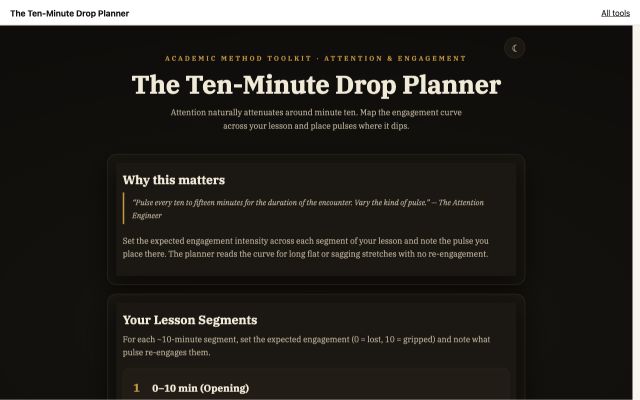
The Attention Drop Planner
Attention keeps no timetable.
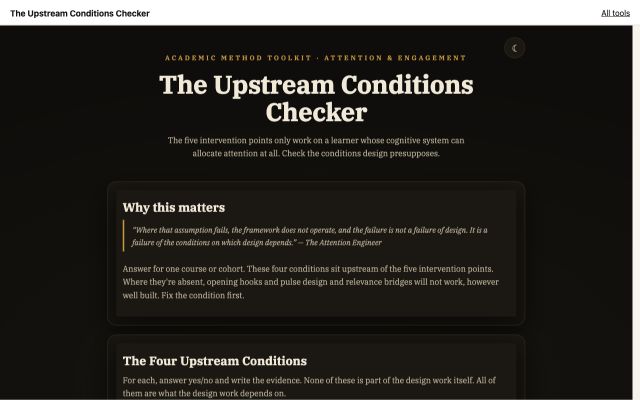
The Upstream Conditions Checker
The five intervention points only work on a learner whose cognitive system can allocate attention at all.

The Assessment Alignment Matrix
Outcomes, content, and assessment must form a tightly coupled system.
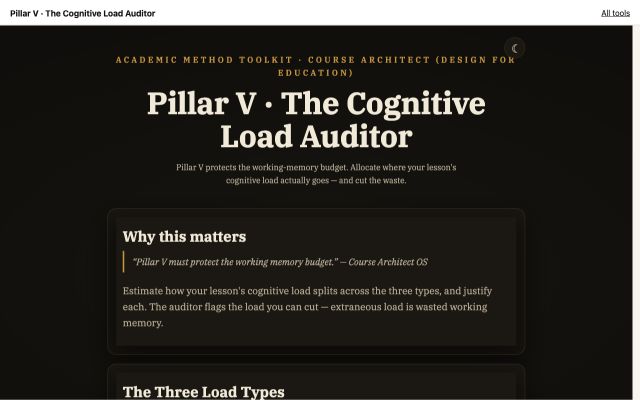
The Cognitive Load Auditor
Pillar V protects the working-memory budget.

The Course Architecture Canvas
The whole Course Architect OS on one canvas.

The Curriculum Coherence Mapper
A coherent course feels designed; an incoherent one feels assembled.

The Design Principles Auditor
Pillar I of Course Architect OS: the operational tools of design.

The Engagement Architecture Auditor
Pillar VI: engagement is architecture, not personality.

The Laws & Logic Defensibility Check
Pillar II asks you to defend every design choice.

The Learner Journey Friction Audit
Drop-off is an architectural variable, not a learner trait.

The Learning Outcomes Architect
Constructive alignment is non-negotiable.
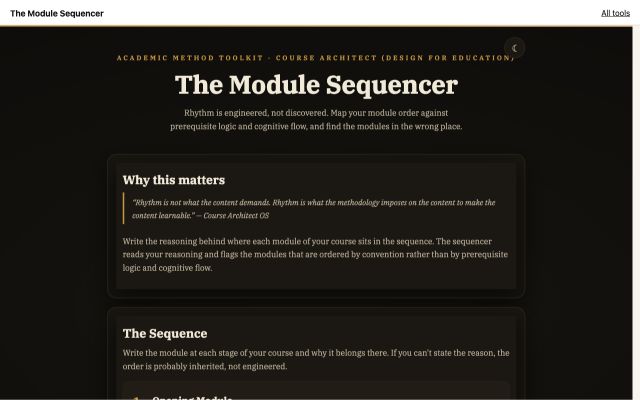
The Module Sequencer
Rhythm is engineered, not discovered.

The Course Readiness Diagnostic
Before you start, know who's walking through the door.

The Practitioner Stance Profiler
Pillar III is about who you are as a designer.

The Retention Engine Designer
Pillar IV: most learning is forgotten by design.

The Six Pillars Diagnostic
Six failure modes end most courses.

The Teaching Lenses Profiler
Architect of Mind frames teaching through fifty-one lenses.

The Classroom Dilemma Simulator
Under pressure you don't reach for a philosophy.

The Feedback Economy Auditor
Feedback is the most powerful and most wasted force in education.

The Lens Pairing Planner
The lens that works for one module is the wrong lens for the next.

The Memory Architect
Forgetting is the default; memory is the exception you engineer.

The Self-Regulation Planner
The best learners regulate their own learning.
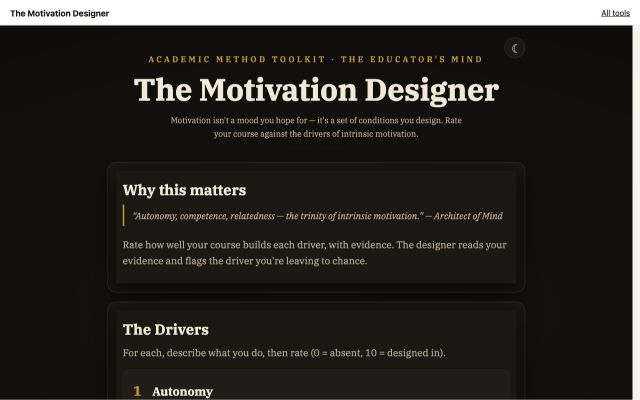
The Motivation Designer
Motivation isn't a mood you hope for — it's a set of conditions you design.
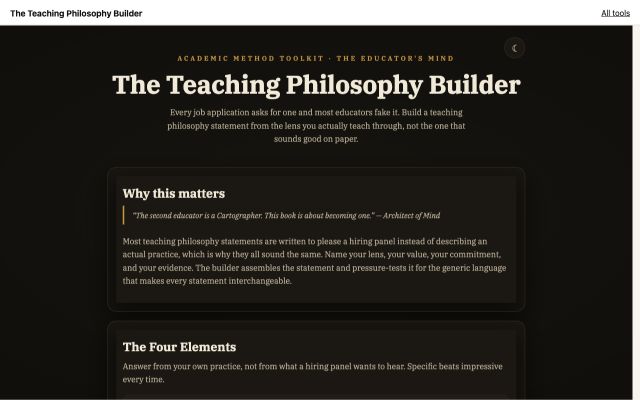
The Teaching Philosophy Builder
Every job application asks for one and most educators fake it.

The Inclusive Design Auditor
Inclusion designed in from the start serves everyone.

Which Educator Are You?
Architect of Mind names fifty-one ways to stand in front of a room.

The Educator's Habits Profiler
Great teaching is a set of daily habits, not a talent.

The Teaching Practice Audit
A whole-practice health check drawn from the 365 Laws of Education.
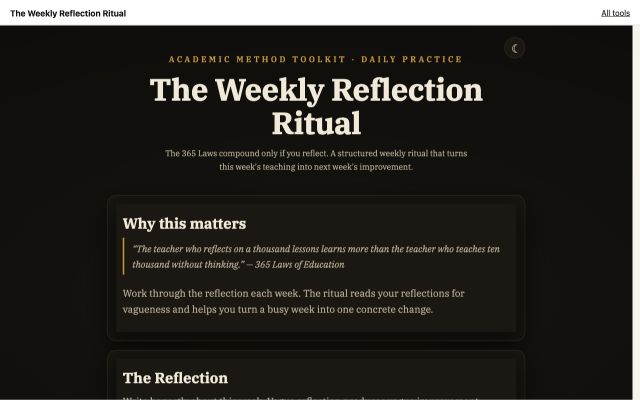
The Weekly Reflection Ritual
The 365 Laws compound only if you reflect.