
The Cinematic Curriculum Method
Build courses like worlds.
Teach like a director.
A complete system for designing education that changes people — using the language, structure and production logic of cinema.
13 modules · 50 lessons · ~813 min
Watch
A look inside

01 — The problem
Education forgot how to design for transformation.
Most courses are built like documents, not journeys. Structured like folders, not worlds. They present content competently and change nobody.
Every meaningful learning experience has a shape: confusion, curiosity, struggle, insight, integration. Education stopped designing for it. Cinema never did — it has spent a century getting strangers to sit in the dark and come out different.
The default course-design toolkit was never built to design a course — it schedules, documents, validates and measures one. Change the tool, change the course.

02 — The method
Cinema re-engineered as pedagogy.
What if your course was designed like a film? Not metaphorically. Literally. What if learners moved through your course the way audiences move through cinema — immersed, transformed, part of a narrative world?
Six pillars. Each one a working part of the method, not a metaphor.
- 01
Learners are protagonists
The learner is on a journey, the educator is directing it, and the curriculum is a narrative arc. Design for identity change, not information transfer.
- 02
Courses are worlds
Great films feel like places. Map your course as a geography — regions, landmarks, thresholds, paths. When learners know where they are, they move with confidence.
- 03
Pacing is pedagogy
Editors know that timing is meaning. Pace complexity, design emotional rhythm, structure rest and intensity deliberately. Learning fails when pacing fails.
- 04
Structure creates freedom
The most creative films are the most precisely structured. Act structure for programmes, sequence logic for modules, scene design for lessons. Frameworks that liberate.
- 05
Visual language is infrastructure
A complete diagram canon — arcs, maps, spirals, grids, compasses, timelines — each with defined meaning and consistent grammar. Cognitive architecture, not decoration.
- 06
Education can be franchised
People return to worlds they care about. Design sequels, spin-offs and return paths. Build an ecosystem, not one course at a time.
03 — Outcomes
What you’ll learn
Director’s Vision & Course Audit
You’ll write your Director’s Vision Statement, a manifesto for your course, then audit your design against the Four Realms. It’s the beginning of your actual course redesign.
The Arc Forest
Your Learner Arc Draft (a 1-2 page narrative of your learner’s transformation), your Emotional Pacing Plan, and your Archetype Coverage.
The World Map of Your Course
Its three layers (aesthetic, conceptual, emotional), its four geographic elements (regions, landmarks, paths, gates), the cast you’ve placed around the learner, and the set design that makes safety possible.
Story Spine & Integrated Design
Define your overall story arc, zoom into one critical sequence and design it backwards from its emotional arc, then verify coherence across Learner Arc, World Map and Story Spine.
The Pacing Grid & Module Audit
Put all three layers of pacing on one real module: score the current Pacing Grid, redesign it against the Five Laws, design one Learning Pulse, then compare before and after.
The Scene-to-Sequence Map
Lay every scene of one of your modules on the editor’s table, as cards, and arrange them by the rhythm that lands, not the order events appear in the curriculum.
The Edit Plan
Launch Readiness, Feedback Architecture, the Six-Pass Edit Plan and the Director’s Verdict for the next twelve months, in one operational document.
A Complete Assessment System
A complete Assessment Blueprint for one course you teach: the Competence Mountain, the Mastery Spiral and Evidence Flow, the Ordeal Design, and the Transformation Narrative.
Integration Map & Course Story
A visual Integration Map of your course, a 500–750-word Course Story written in three acts, and a five-question Integration Analysis.
Your Capstone Assessment
Design the artifact that proves identity transformation: the Capstone Description, the Mastery Criteria, the Multiple Forms of Evidence, the Final Arc Timeline and the Transformation Evidence.
Your Return Path Plan
The document that names what your learner walks back into, what they carry with them, where they reach for it, and how the cohort epilogue arc holds the change in place.
Your Cinematic Course Bible
The document the next version of your course will be built from: Vision & Purpose, Design Architecture, All Course Materials, Production & Operations, Systems & Processes, Data & Feedback.
04 — Curriculum
Inside the course
M00 · Welcome to the World 2 lessons · 18 min
What if your course was designed like a film? The door in, and five new tools to replace a toolkit that was never built to design a course.
- M00 · Orientation — Welcome to the WorldWhat if your course was designed like a film? Literally. This is the door in.Runtime 22 minPillar WorldbuildingFormat Orientation · Interactive · 1 Workshop
- M00 · L02 — Tools of the World18 minYour toolkit schedules and measures a course. It can't design one. Five new tools.Pillar CraftFormat Orientation · Interactive · 1 Workshop
M01 · The Cinematic Foundations 4 lessons · 78 min
Direct an experience instead of covering material. Begin with a single sentence, argue a theme under the surface, and write your Director's Vision Statement.
- M01 · L01 — The Director's Mindset28 minThe difference between covering material and directing an experience.Pillar Clarity Through StoryFormat Interactive · 3 Acts · 1 Diagnostic
- M01 · L02 — The Logline of Learning25 minBegin with one sentence that names the transformation, not the topic.Pillar Clarity Through StoryFormat Interactive · 3 Acts · 1 Acid Test
- M01 · L03 — Themes and Motifs25 minYour course argues a proposition under the surface, taught by stealth.Pillar Clarity Through StoryFormat Interactive · 3 Acts · 1 Acid Test
- M01 · Capstone — Director's Vision & Course AuditWrite your Director's Vision Statement, then audit it against the Four Realms.Parts 3Type CapstoneAI Evaluated
M02 · The Protagonist Arc 4 lessons · 69 min
Design for one real learner: who walks in, who walks out, and the five archetypes in the room. You finish with your Learner Arc Draft and Emotional Pacing Plan.
- M02 · L01 — The Learner as Protagonist23 minStop designing for a ghost. Design for one real person in one real chair on a Tuesday.Pillar Learner-Centred DesignFormat Interactive · 3 Acts · 1 Protagonist Sketch
- M02 · L02 — Before & After States23 minA course is the gap between who walks in on day one and who walks out at the end.Pillar Identity TransformationFormat Interactive · 3 Acts · 1 Transformation Audit
- M02 · L03 — Archetypes, Beats & Emotional Pacing23 minFive archetypes share your room. Design the rhythm that holds all five.Pillar Emotional Pacing as PedagogyFormat Interactive · 3 Acts · 1 Pacing Grid
- M02 · Capstone — The Arc ForestWrite your Learner Arc Draft, Emotional Pacing Plan and Archetype Coverage.Parts 3Type CapstoneAI Evaluated
M03 · Worldbuilding for Education 4 lessons · 69 min
Build the world your course happens in: its three layers, the cast around the learner, and safety as architecture. You finish with a world map of your course.
- M03 · L01 — The Three Layers of a Learning World23 minA course isn't a stack of topics. It's a world that teaches before the lesson does.Pillar Worldbuilding for EducationFormat Interactive · 3 Acts · 1 Workshop
- M03 · L02 — Casting Your Course23 minEvery course is a casting decision. See who you cast, and the roles left empty.Pillar Clarity Through StoryFormat Interactive · 3 Acts · 1 Diagnostic
- M03 · L03 — Psychological Safety as Set Design23 minSafety is architecture, not atmosphere: rules, failure, feedback.Pillar Clarity Through StoryFormat Interactive · 3 Acts · 1 Diagnostic
- M03 · Capstone — The World Map of Your CourseA complete world map of your course: layers, geography, cast, set design.Parts 3Type CapstoneAI Evaluated
M04 · Story Structure in Curriculum 4 lessons · 93 min
Name the beats where the learner changes, choose one of six structures, and align it at course, module and lesson scale. You finish with your story spine.
- M04 · L01 — Beats, Turning Points & the Story Spine32 minName the seven moments the learner changes. Draw that spine first.Pillar Story Structure in CurriculumFormat Interactive · 3 Acts · 1 Workshop
- M04 · L02 — The Six Cinematic Structures32 minEvery course follows one of six structures. Choose yours before the calendar does.Pillar Story Structure in CurriculumFormat Interactive · 3 Acts · 1 Workshop
- M04 · L03 — The Three-Level Structural Map29 minOne three-act shape at three scales: semester, module, lesson. Tune all three.Pillar Story Structure in CurriculumFormat Interactive · 3 Acts · 1 Workshop
- M04 · Capstone — Story Spine & Integrated DesignMap a three-act, six-sequence story spine, then design one sequence backwards.Parts 3Type CapstoneAI Evaluated
M05 · Cinematic Pacing & Rhythm 4 lessons · 71 min
Pacing is the felt speed of the learner's experience. Learn its five laws and a module's emotional arc, then audit one real module on the Pacing Grid.
- M05 · L01 — What Pacing Actually Is23 minPacing isn't how fast you teach. It's the felt speed of the learner's experience.Pillar Pacing as ArchitectureFormat Interactive · 3 Acts · 1 Workshop
- M05 · L02 — The Five Laws of Cinematic Pacing24 minFive laws of pacing, so you know which one is missing before the room does.Pillar Pacing as ArchitectureFormat Interactive · 3 Acts · 1 Workshop
- M05 · L03 — The Emotional Arc of a Module24 minEvery module has an emotional arc, mapped or not. Make the Dip a designed beat.Pillar Pacing as ArchitectureFormat Interactive · 3 Acts · 1 Workshop
- M05 · Capstone — The Pacing Grid & Module AuditScore one module's Pacing Grid, redesign it against the Five Laws, compare.Parts 3Type CapstoneAI Evaluated
M06 · Scenes & Sequences 4 lessons · 71 min
What makes a scene, the anatomy of a lesson, and why a module is a chain, not a stack. You finish by mapping one module's scenes into sequences.
- M06 · L01 — What Makes a Scene a Scene23 minA scene ends differently from how it begins. Everything else is set dressing.Pillar Scene as Atomic UnitFormat Interactive · 3 Acts · 1 Workshop
- M06 · L02 — Anatomy of a Cinematic Lesson24 minCold Open, Body, Beat Moment, Close: a lesson as architecture, not agenda.Pillar Lesson as ArchitectureFormat Interactive · 3 Acts · 1 Workshop
- M06 · L03 — Modules as Sequences24 minA chain of scenes earns its payoff. A stack of scenes never does.Pillar Structure as NarrativeFormat Interactive · 3 Acts · 1 Workshop
- M06 · Capstone — The Scene-to-Sequence MapLay one module's scenes out as cards and arrange them by the rhythm that lands.Parts 3Type CapstoneAI Evaluated
M07 · The Craft of Iteration 4 lessons · 69 min
Ship the rough cut on purpose, design feedback in contact with the cohort, and edit in six passes. You finish with an Edit Plan for the next twelve months.
- M07 · L01 — The Myth of the Perfect Course23 minShip rough cuts on purpose. Stop mistaking the polish for the work.Pillar Craft as IterationFormat Interactive · 3 Acts · 1 Diagnostic
- M07 · L02 — Feedback Loops That Actually Work23 minFeedback after the cohort leaves isn't a loop, it's an autopsy. Design in contact.Pillar Craft as IterationFormat Interactive · 3 Acts · 1 Diagnostic
- M07 · L03 — The Iterative Edit23 minEdit in six passes: structure, clarity, pacing, tone, technical polish, final review.Pillar Craft as IterationFormat Interactive · 3 Acts · 1 Diagnostic
- M07 · Capstone — The Edit PlanLaunch readiness, feedback architecture and a six-pass edit plan, in one document.Parts 4Type CapstoneAI Evaluated
M08 · The Ordeal Zone 4 lessons · 55 min
Calibrate productive struggle, design the ordeal backward from its verdict, and build the architecture of breakthrough. You finish with a complete assessment system.
- M08 · L01 — Productive vs Destructive Struggle18 minHold learners in productive discomfort without rescuing them. Read the four zones.Pillar Assessment is TransformationFormat Interactive · 3 Acts · 1 Calibrator
- M08 · L02 — Designing the Ordeal18 minName the verdict first, then engineer every week before it backward.Pillar Assessment is TransformationFormat Interactive · 3 Acts · 1 Evaluator
- M08 · L03 — Breakthrough Architecture19 minBreakthroughs aren't accidents or gifts. Build the architecture weeks before they arrive.Pillar Assessment is TransformationFormat Interactive · 3 Acts · 1 Evaluator
- M08 · Capstone — Design a Complete Assessment SystemA complete Assessment Blueprint for one course you teach.Parts 4Type CapstoneAI Evaluated
M09 · The Resolution 4 lessons · 54 min
Why courses stop instead of resolving, how to make the capstone the inevitable last beat, and how to map the whole. You finish with an Integration Map and Course Story.
- M09 · L01 — Why Courses End Wrong18 minAn integrated course resolves. A fragmented course ends. Learn to tell which you've built.Pillar Narrative CoherenceFormat Interactive · 3 Acts · 1 Audit
- M09 · L02 — The Final Performance18 minA capstone is engineered, not appended. Make it the only possible last beat.Pillar Narrative CoherenceFormat Interactive · 3 Acts · 1 Studio
- M09 · L03 — The Resolution Sequence18 minA course is the map of how its modules integrate. Draw it, then revise.Pillar Narrative CoherenceFormat Interactive · 3 Acts · 1 Studio
- M09 · Capstone — Integration Map & Course StoryAn Integration Map, a three-act Course Story and a five-question Integration Analysis.Parts 4Type CapstoneAI Evaluated
M10 · The Summit of Mastery 4 lessons · 54 min
The real outcome is identity change. Use the community as its mirror and mastery as a spiral, then design the capstone that proves who learners have become.
- M10 · L01 — Identity Change as the Real Outcome18 minA capstone that proves who learners have become, not what they learned.Pillar Mastery & TransformationFormat Interactive · 3 Acts · 1 Audit
- M10 · L02 — Community as Mirror18 minThe community is the witness. Turn a private change into a public identity.Pillar Mastery & TransformationFormat Interactive · 3 Acts · 1 Designer
- M10 · L03 — Fandom Culture & the Mastery Arc18 minMastery is a spiral, not a finish line. Build the culture that keeps learners practising.Pillar Mastery & TransformationFormat Interactive · 3 Acts · 1 Designer
- M10 · Capstone — Design Your Capstone AssessmentDesign the artifact that proves identity transformation.Parts 5Type CapstoneAI Evaluated
M11 · The Architecture of the Return 4 lessons · 54 min
Why transfer fails, the portable tools that outlast the course, and the months after the final session. You finish with your Return Path Plan.
- M11 · L01 — Why Transfer Fails18 minTransfer is the only honest measure. The four failure modes that kill it.Pillar Transfer, Toolkit & EpilogueFormat Interactive · 3 Acts · 1 Diagnostic
- M11 · L02 — The Transfer Toolkit18 minTools resist evaporation; ideas don't. Build ones to reach for on Monday.Pillar Transfer, Toolkit & EpilogueFormat Interactive · 3 Acts · 1 Toolkit Builder
- M11 · L03 — The Epilogue Arc18 minDesign the months after the final session. Stop being the teacher; become the host.Pillar Transfer, Toolkit & EpilogueFormat Interactive · 3 Acts · 1 Epilogue Arc Planner
- M11 · Capstone — Design Your Return Path PlanWhat your learner walks back into, what they carry, and how the change holds.Parts 3Type CapstoneAI Evaluated
M12 · The Director’s Studio 4 lessons · 58 min
Write the page that signs your work, turn twelve frameworks into one practice, and assemble the Cinematic Course Bible your next course is built from.
- M12 · L01 — The Director's Vision Statement18 minWrite the single page that signs every course you'll ever build.Pillar Vision, Integration & ContinuationFormat Interactive · 3 Acts · 1 Vision Evaluator
- M12 · L02 — Integrating Everything18 minFrom a stack of twelve frameworks to one practice, with the seams underneath.Pillar Vision, Integration & ContinuationFormat Interactive · 3 Acts · 1 Integration Audit
- M12 · L03 — What Comes Next22 minThe doorway out: four directions the work walks in past the course.Pillar Vision, Integration & ContinuationFormat Interactive · 3 Acts · 1 Director's Cut Planner
- M12 · Capstone — Assemble Your Cinematic Course BibleAssemble the Course Bible your next course is built from, and test it against your vision.Parts 3Type CapstoneAI Evaluated
05 — The tools
Tools included in this course
The course includes the Cinematic Curriculum Method Toolkit: all 39 tools, worked through inside your account.
Interactive instruments that score a course against the method instead of describing it.
M00 · Welcome to the World
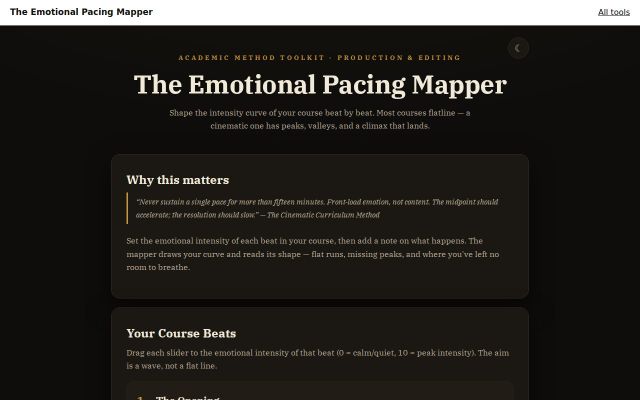 The Emotional Pacing MapperShape the intensity curve of your course beat by beat.
M01 · The Cinematic Foundations
Show all 39 toolsShow fewer

M02 · The Protagonist Arc
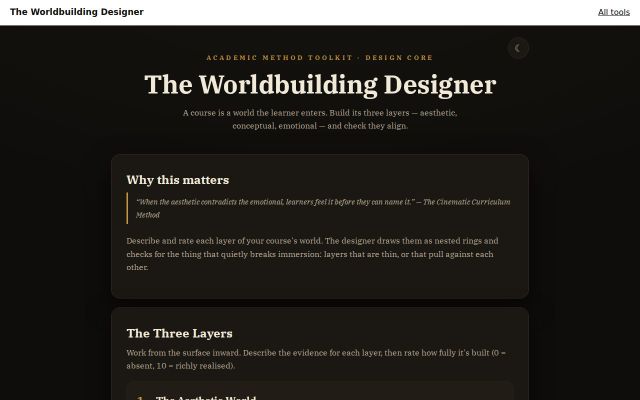
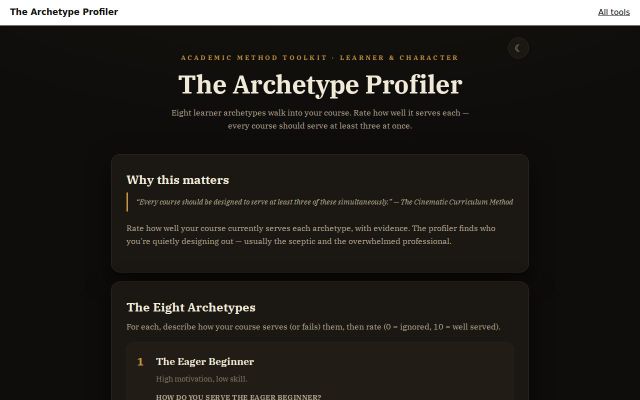
M03 · Worldbuilding for Education
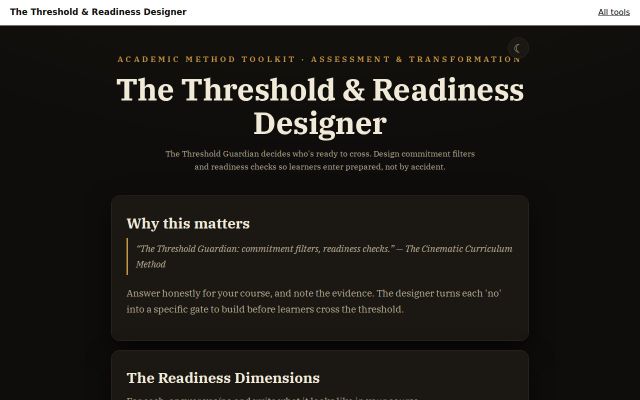 The Threshold & Readiness DesignerThe Threshold Guardian decides who's ready to cross.
 The Character Roles MapperEvery learning environment has a cast.
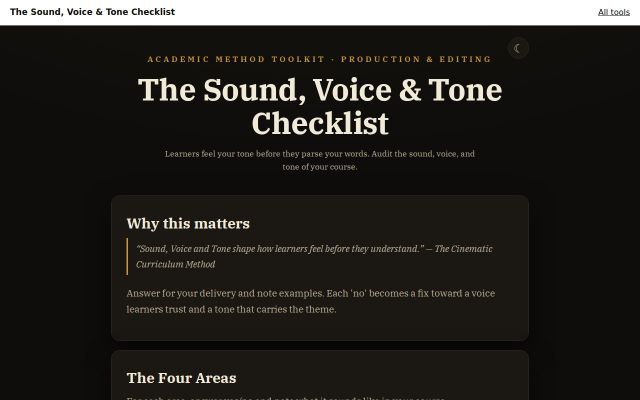 The Sound, Voice & Tone ChecklistLearners feel your tone before they parse your words.
 The Visual Language AuditorProduction design isn't decoration — it directs attention.
M04 · Story Structure in Curriculum
M05 · Cinematic Pacing & Rhythm

M06 · Scenes & Sequences
M07 · The Craft of Iteration
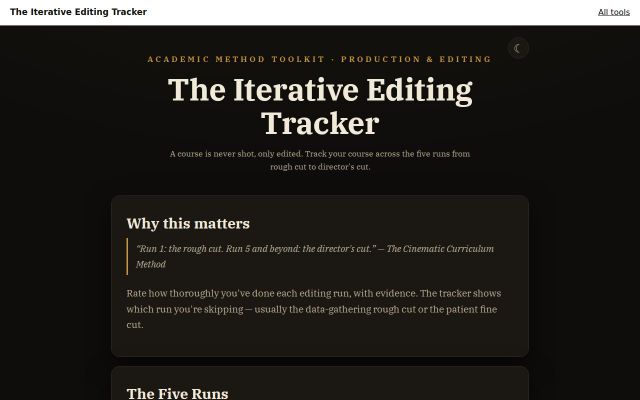
M08 · The Ordeal Zone
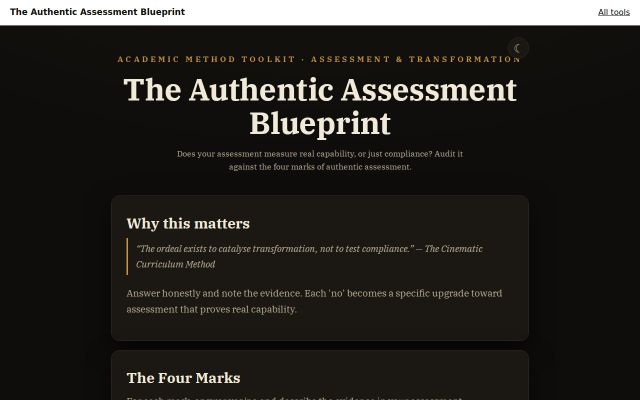

M09 · The Resolution
M10 · The Summit of Mastery
 The Fandom AuditorAudit your course against the six psychological forces that turn a cohort into a culture — the kind of belonging that feels like fandom.The Rituals of Becoming DesignerRituals are the heartbeat of culture and the markers of identity change.The Identity Transformation ArcChange the identity and behaviour follows.The Lie & Possible Selves WorksheetEvery transformation starts by naming the lie the learner believes — and making the possible self vivid enough to pull them forward.
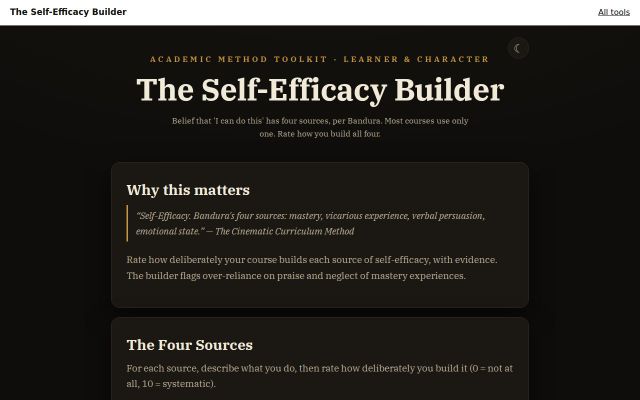 The Self-Efficacy BuilderBelief that 'I can do this' has four sources, per Bandura.
M11 · The Architecture of the Return
M12 · The Director’s Studio


Assessment & Transformation

06 — Who it is for
For everyone who feels something is off about education.
- Educators who want their teaching to change people, not just transfer information.
- Course creators tired of producing lifeless content and ready to build something that lands.
- Instructional designers frustrated by sterile frameworks and looking for one with both rigour and soul.
- Programme leaders redesigning degrees or curricula and wanting coherence rather than compliance.
- Creative professionals moving into education who want to bring the craft with them instead of leaving it at the door.
“My course works, but it doesn’t land. Students finish the material and don’t change. There has to be a better way to structure this.” If that sounds familiar, this was written for you.
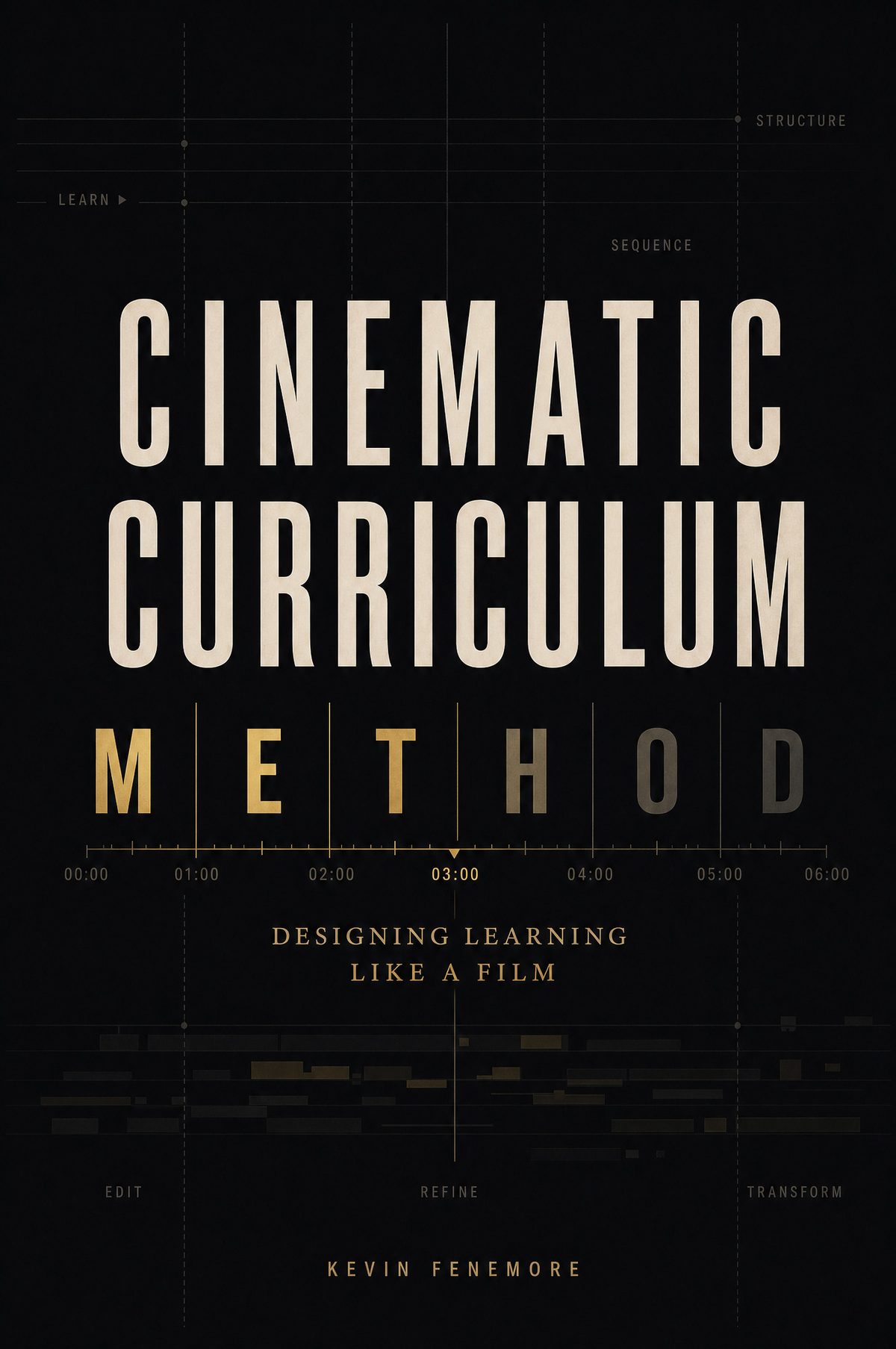
The book
The Cinematic Curriculum Method
The complete methodology in print — from director’s vision to learner transformation. The visual diagram canon, act structures, sequence logic, scene design, worldbuilding templates, case studies and failure modes.
The book is the source text. The course turns the method into a curriculum you actually build.
What you get for the founder price: the full thirteen-module course and the Cinematic Curriculum Method book.

07 — Your instructor
Kevin Fenemore
Kevin Fenemore is a filmmaker by training and spent fifteen years inside higher education — Course Leader, Programme Leader, and Dean of Faculty in São Paulo. He designed four undergraduate degree programmes from scratch and hundreds of courses across FE, HE, CPD and industry, while working professionally in film, visual effects, animation and photography.
He left school at fifteen with no qualifications and went to university in his mid-twenties as a mature student. The teaching came first: at eighteen he was teaching rock climbing, kayaking and English to Spanish children.
Senior Lecturer and Course Leader, Leeds Arts University · Programme Leader and Academic Director, University of Bradford · Dean of Faculty, EBAC São Paulo. He co-created the UK’s first BSc in Virtual and Augmented Reality, and also built Fix It In Post, a national education-industry festival, and the Pipeline Pedagogy framework, developed in São Paulo.
This is not theory written at arm’s length. It is the method he used on programmes that had to be validated, audited and defended.
Enrol
Start today
£150
- Thirteen modules, thirty-eight lessons and twelve capstones
- The lessons, their workbooks and their interactive material, through your account on this site
- An AI tutor and AI feedback on your work
- The Cinematic Curriculum Method Toolkit: all 39 tools
- The Cinematic Curriculum Method book
- Self-paced, with no cohort to keep up with
- Course access with no end date
- One payment, no subscription, no renewal
One payment · no subscription · the Cinematic Curriculum Method book included · by ordering you accept our Terms of Sale
Questions
Before you ask
What is the Cinematic Curriculum Method?
A complete system for designing courses using the structural logic of film — act structure, sequence, scene, pacing and worldbuilding — applied to curriculum.
What is in the Cinematic Curriculum Method?
Thirteen modules, thirty-eight lessons and twelve capstones. The lessons teach the method; the capstones make you apply it to your own course, one piece at a time, until the course is built. You get the lessons, their workbooks and their interactive material through your account on this site, with an AI tutor and AI feedback on your work. These are teaching aids. The Cinematic Curriculum Method also includes the Cinematic Curriculum Method Toolkit: all 39 tools, worked through inside your account.
Who is the Cinematic Curriculum Method for?
Educators, course creators, instructional designers and programme leaders who can already write content and cannot work out why the finished thing does not land. It assumes you have something to build.
Do I need a film background?
No. The method borrows filmmaking’s structural thinking, not its equipment. Everything cinematic is explained from first principles as it is introduced.
How long does the Cinematic Curriculum Method take?
It is self-paced and there is no cohort to keep up with. The capstones are the work; how fast you move through them depends on the course you are building.
What do I get at the Founders’ Deal price?
The full thirteen-module course, the Cinematic Curriculum Method book and the Toolkit’s 39 tools. Presale £150 until 1 Dec 2026; Founder price £199 to 1 Jan 2027; Second wave £229 to 28 Mar 2027 (Easter Sunday); Final wave £259 to 1 Jun 2027; from then the course is £300.
Does my price change when a wave ends?
No. A price change never affects an order already placed, and it never affects access you have already bought.
Is it one payment?
Yes. One payment, no subscription, no renewal.
Can I get a refund?
Yes. You have 14 days from the date of purchase to cancel and get a full refund, whether or not you have started the course. You do not have to give a reason. Email legal@academicmethod.com from the address you bought with and say you want to cancel.
How do I get access after I buy?
Your purchase is tied to the email address you check out with, and the course opens in your account. If you are new here, we email you an invitation to set your own password. Sign in at any time from the link in the site header.
Is there a certificate?
Yes. When you have completed every lesson, a certificate of completion is ready to download from My courses.
What is the AI tutor?
The tutor answers your questions from the course material, and AI feedback comments on your workbook answers. Both are generated by a language model and can be wrong, so check anything that matters against the course material. AI feedback is not an accredited assessment. Both carry fair-use limits, shown in the course.
What format is the book?
The Cinematic Curriculum Method book downloads as one .zip file holding the EPUB and a PDF. A paperback is sold separately on Amazon.
Can my team or institution buy it?
Each account is for one person, and a login is not to be shared. If you are buying on behalf of an organisation, write to hello@cognitionblueprint.com before you buy: different terms may apply.
Do I own what I buy?
What you buy is licensed to you, not sold, for your own learning and your own professional practice. Course access has no end date; we will give you at least 90 days’ notice, by email, if a course is ever to be withdrawn. There is no marketplace between us, and nothing needs renewing.
What currency are prices in?
Pounds sterling, with no VAT added: Academic Method Limited is not registered for VAT. Outside the UK, Stripe’s checkout may show the price in your own currency with a conversion fee of 2–4% included. You can choose to pay in pounds instead.
Something isn’t working.
Write to hello@cognitionblueprint.com from the address you bought with, and say what you were trying to open and what happened instead.
Ready when you are
The Cinematic Curriculum Method
A complete system for designing education that changes people — using the language, structure and production logic of cinema.
Enrol at the founders’ price — £150
One payment · no subscription · the Cinematic Curriculum Method book included · by ordering you accept our Terms of Sale