
Description
The complete toolkit behind the Cinematic Curriculum Method: 39 interactive tools split across six areas — course design (Logline Builder, Theme & Motif Designer, Worldbuilding Designer, Three-Act Weighting Calculator), production and editing (Visual Language Auditor, Sound Voice & Tone Checklist, Iterative Editing Tracker), assessment and transformation (Ordeal Designer, Rubric & Evidence Portfolio Builder, Transfer Framework Planner), attention and pacing, culture and community, and marketing and launch. Each tool is a structured worksheet: you fill in your course details, it scores or maps your answer against the method’s frameworks, and hands back a concrete verdict rather than a generic checklist. Built for course creators and educators who want the full system in one purchase rather than a single fix, worked through inside your account — no downloads, no separate licence keys to juggle.
What’s inside 39 tools
Start here
The Course Treatment Generator
Write the treatment first. The book puts it before the first lesson.
The Logline Builder
Then compress it to one sentence you can test every module against.

The Course Audit Tool
When a draft exists, audit the whole course in one pass.
Design core 9
The Course Treatment Generator
Before you build a single lesson, write the treatment — the pre-production document that captures what your course is really about.
The Director's Treatment Template
A director's treatment captures the feel of a course before a frame is shot — tone, look, voice, and the promise to the learner.
The Five-Part Sequence Builder
Every cinematic lesson has the shape of a scene.
The Logline Builder
Distil your whole course into one sentence — the transformation at its heart.
The Save the Cat Beat Sheet
Snyder's fifteen beats, adapted for a course.
The Story Circle Mapper
Dan Harmon's eight-step circle, applied to learning.
The Story Structure Mapper
Map your course onto the beats of a story — the structure that's held human attention for millennia.
The Theme & Motif Designer
Your course has a surface topic and a deeper argument.
The Three-Act Weighting Calculator
Most courses front-load setup and rush the payoff.
Learner and character 3
The Identity Transformation Arc
Change the identity and behaviour follows.
The Learner's Arc Designer
Seven psychological mechanisms drive real transformation.
The Lie & Possible Selves Worksheet
Every transformation starts by naming the lie the learner believes — and making the possible self vivid enough to pull them forward.
Assessment and transformation 4
The Ordeal Designer
Plot your course's challenges on the two axes that decide whether difficulty transforms or just threatens: how hard it is, and how safe it…
The Resolution Planner
How a course ends decides what learners keep.
The Rubric & Evidence-Portfolio Builder
Assessment should prove who the learner has become.
The Transfer Framework Planner
Learning that stays in the classroom isn't learning.
Culture and engagement 2
The Community Architecture Designer
Community doesn't happen by adding a forum.
The Rituals of Becoming Designer
Rituals are the heartbeat of culture and the markers of identity change.
Production and editing 2
The Braintrust Session Planner
Pixar's Braintrust gives honest critique in service of the work, never the person.
The Director's Notebook
After every cohort, the director reflects before the next cut.
Marketing and launch 2
The Audience & Avatar Profiler
You can't market to a blur.
The Trailer Script Structurer
A course trailer is a movie trailer.
More tools 17
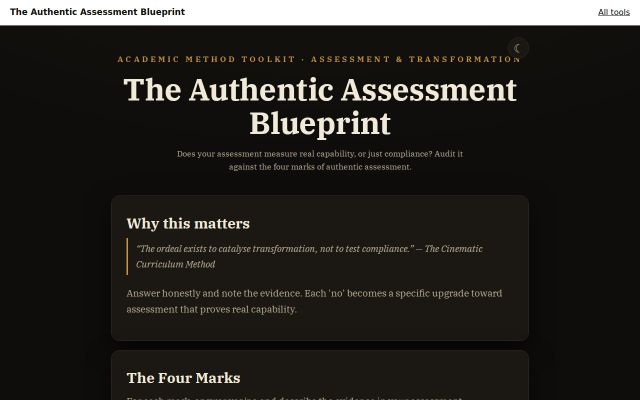
The Authentic Assessment Blueprint
Does your assessment measure real capability, or just compliance?

The Psychological Safety Audit
Safety is the foundation for courage — and courage is what learning requires.
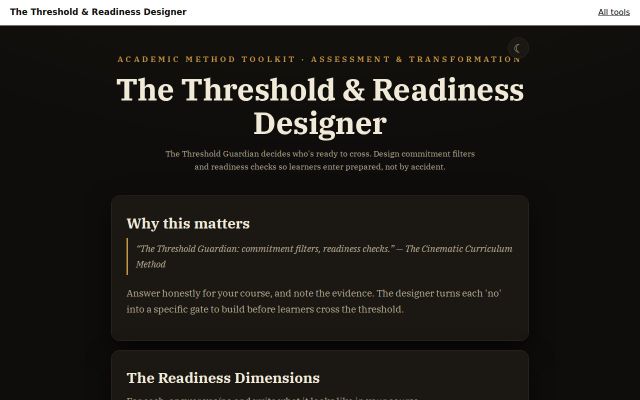
The Threshold & Readiness Designer
The Threshold Guardian decides who's ready to cross.

The Fandom Auditor
Audit your course against the six psychological forces that turn a cohort into a culture — the kind of belonging that feels like fandom.
The Course Audit Tool
A whole-course health check against the Cinematic Curriculum Method.

The Pacing Laws Auditor
Five laws govern whether a course breathes or drones.

The Worldbuilding Designer
A course is a world the learner enters.
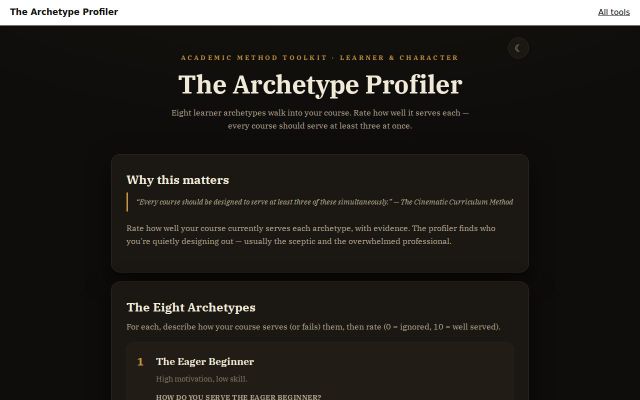
The Archetype Profiler
Eight learner archetypes walk into your course.

The Character Roles Mapper
Every learning environment has a cast.
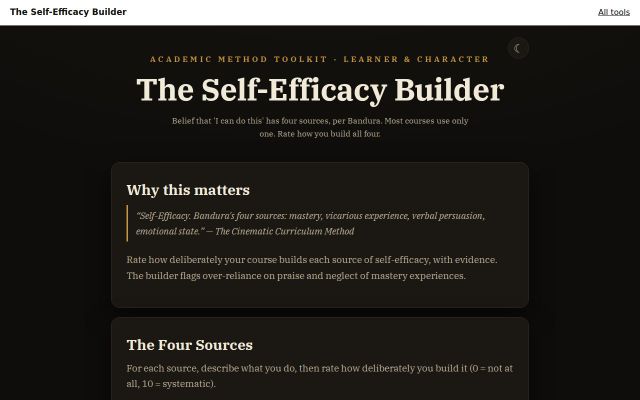
The Self-Efficacy Builder
Belief that 'I can do this' has four sources, per Bandura.

The Launch Plan Auditor
Most launches fail before they start.

The Course Promise Builder
A course that promises everything to everyone sells to no one.

The Emotional Pacing Mapper
Shape the intensity curve of your course beat by beat.
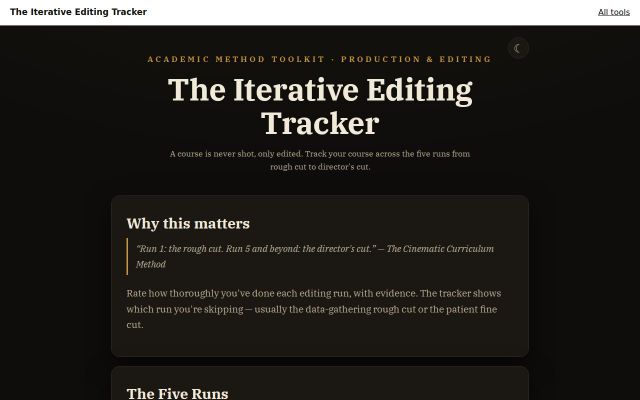
The Iterative Editing Tracker
A course is never shot, only edited.

The Murch Rule-of-Six Auditor
Walter Murch ranked six priorities for every edit.

The Sound, Voice & Tone Checklist
Learners feel your tone before they parse your words.

The Visual Language Auditor
Production design isn't decoration — it directs attention.