
Description
Eleven tools for keeping people engaged across an entire course, not just one lesson: Affordance Auditor, 4E Cascade Mapper, Four Principles Checker, Opening Designer, Attention Drop, Relevance Gap Analyzer, Challenge Zone Calibrator, and Architecture of Return, plus the Emotional Pacing Mapper, Pacing Laws Auditor, and Engagement Architecture tool. Where the standalone Attention Toolkit covers a single lesson, this bundle scales the same thinking across a whole course.
What’s inside 11 tools

The Pacing Laws Auditor
Five laws govern whether a course breathes or drones. Rate your course against each, with evidence.

The Emotional Pacing Mapper
Shape the intensity curve of your course beat by beat. Most courses flatline — a cinematic one has peaks, valleys, and a climax that lands.
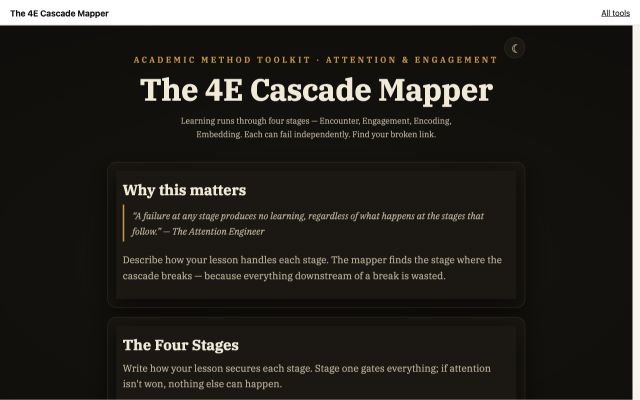
The 4E Cascade Mapper
Learning runs through four stages — Encounter, Engagement, Encoding, Embedding. Each can fail independently.

The Attention Affordance Auditor
The complete diagnostic from Attention Engineer. Audit any lesson against the five points where attention is won or lost.

The Architecture of Return Designer
Learning lives or dies in the gaps between sessions. Design the spaces between encounters as deliberately as the encounters.
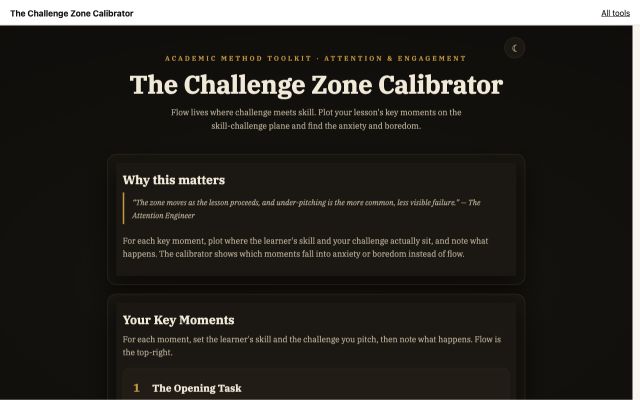
The Challenge Zone Calibrator
Flow lives where challenge meets skill. Plot your lesson's key moments on the skill-challenge plane and find the anxiety and boredom.
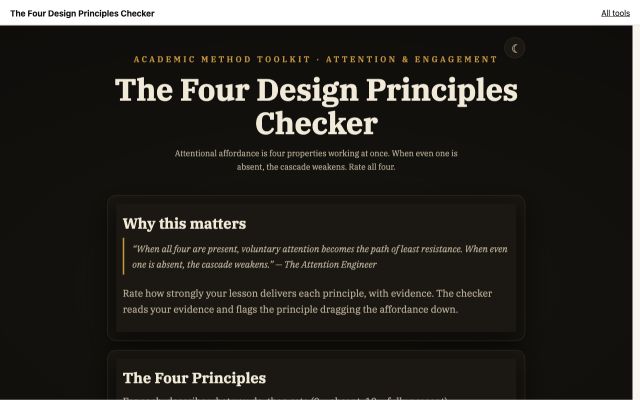
The Four Design Principles Checker
Attentional affordance is four properties working at once. When even one is absent, the cascade weakens.

The Opening Designer
The opening decides whether the encounter earns attention at all. Design the five moves that install attention before any content.

The Relevance Gap Analyzer
Learners quietly stop asking 'why am I learning this?' and quietly stop attending. Design the five moves that keep relevance alive.
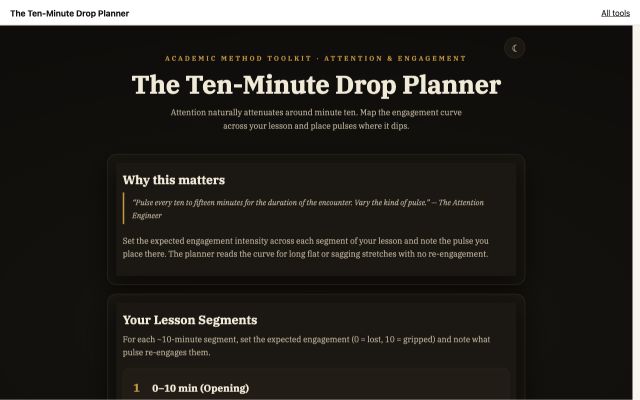
The Attention Drop Planner
Attention keeps no timetable. Plan where a long session is likely to lose people, and reset before it does.

The Engagement Architecture Auditor
Pillar VI: engagement is architecture, not personality. Audit the structures that generate attention and motivation by design.