
Description
Eleven tools for the drafting-and-editing stage of building a course: the Five-Part Sequence Builder, Save the Cat Beat Sheet, Story Circle Mapper, and Director’s Treatment Template for structuring lessons; the Visual Language Auditor, Sound Voice & Tone Checklist, Murch Rule-of-Six Auditor, Iterative Editing Tracker, and Director’s Notebook for editing them until they land; and the Cognitive Load Auditor and Memory Architect for checking they’re not overloading the learner. Built for turning a course outline into finished lessons, decks, and materials.
What’s inside 11 tools
Design core 4
The Director's Treatment Template
A director's treatment captures the feel of a course before a frame is shot — tone, look, voice, and the promise to the learner.
The Five-Part Sequence Builder
Every cinematic lesson has the shape of a scene.
The Save the Cat Beat Sheet
Snyder's fifteen beats, adapted for a course.
The Story Circle Mapper
Dan Harmon's eight-step circle, applied to learning.
Production and editing 1
The Director's Notebook
After every cohort, the director reflects before the next cut.
More tools 6
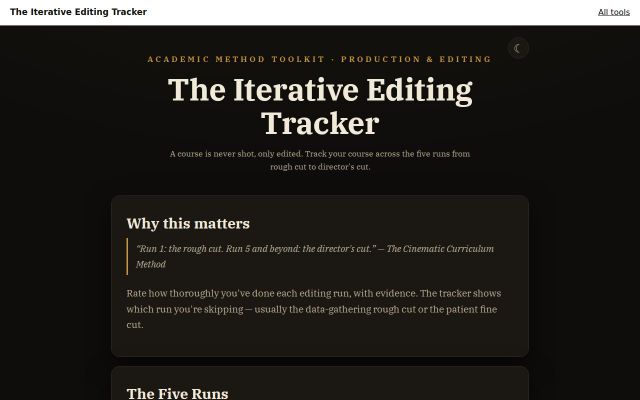
The Iterative Editing Tracker
A course is never shot, only edited.
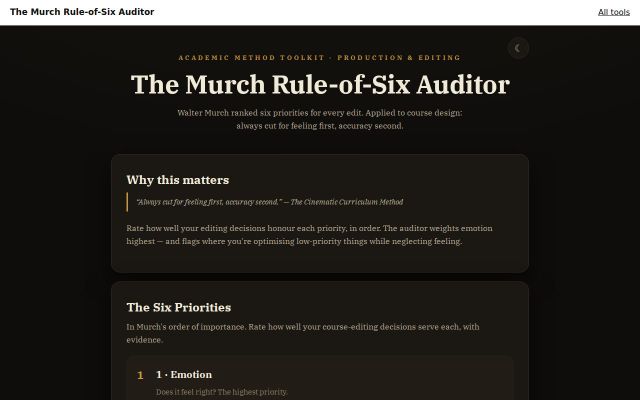
The Murch Rule-of-Six Auditor
Walter Murch ranked six priorities for every edit.
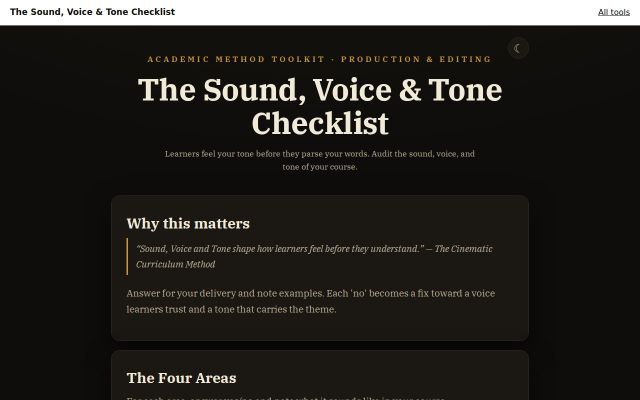
The Sound, Voice & Tone Checklist
Learners feel your tone before they parse your words.

The Visual Language Auditor
Production design isn't decoration — it directs attention.

The Cognitive Load Auditor
Pillar V protects the working-memory budget.

The Memory Architect
Forgetting is the default; memory is the exception you engineer.